EPICS CAR – Creating Accessible Racing
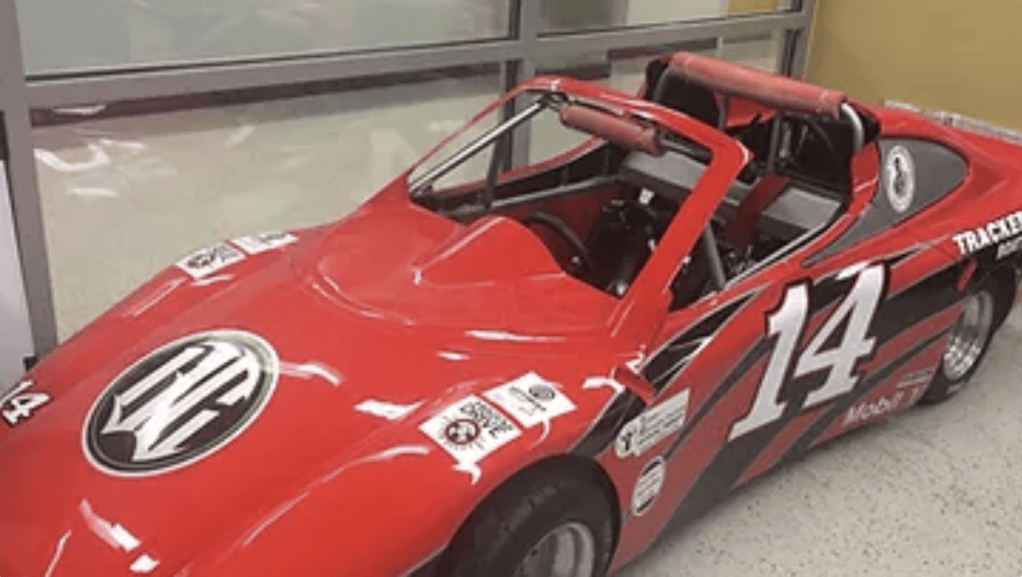
Design and build features to accommodate drivers (predominantly children) with special needs. Past projects included two-seat, soap derby cars. Current project works with Go-Baby-Go initiative.
Corporate Sponsor:

Industry Advisor:

Description: The Purdue University EPICS CAR team partners with various organizations to help children with disabilities experience the thrill of driving and racing. The idea is to increase children’s confidence and self-esteem and encourage participation in social activities with their peers. The CAR team is responsible for designing, testing, and implementing special features or mechanisms that allow for safe car steering. The goal is to remove steering control from a child in the case of dangerous driving and reinstate steering control in safe driving conditions. The team previously built and delivered a prototype tested and reviewed at the Ford Wilson Race of
Champions annual race.
Mission: Increase children’s confidence and self-esteem and encourage their participation in social activities with their peers.
Impact: Children with disabilities will experience a driving sell-propelled car outdoors and have an enriching involvement with their family, friends, and peers.
Area: Access and Abilities
Wilson Race of Champions
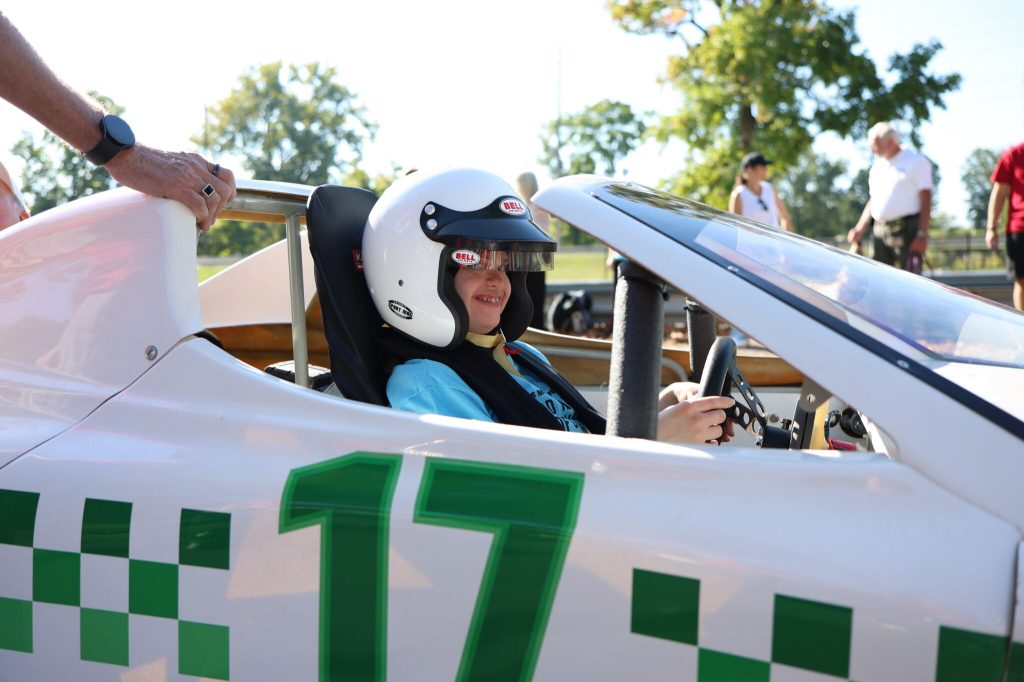
The Ford Wilson Race of Champions soapbox derby provides children and adults with developmental, cognitive, and physical disabilities the opportunity to become a racing champion.
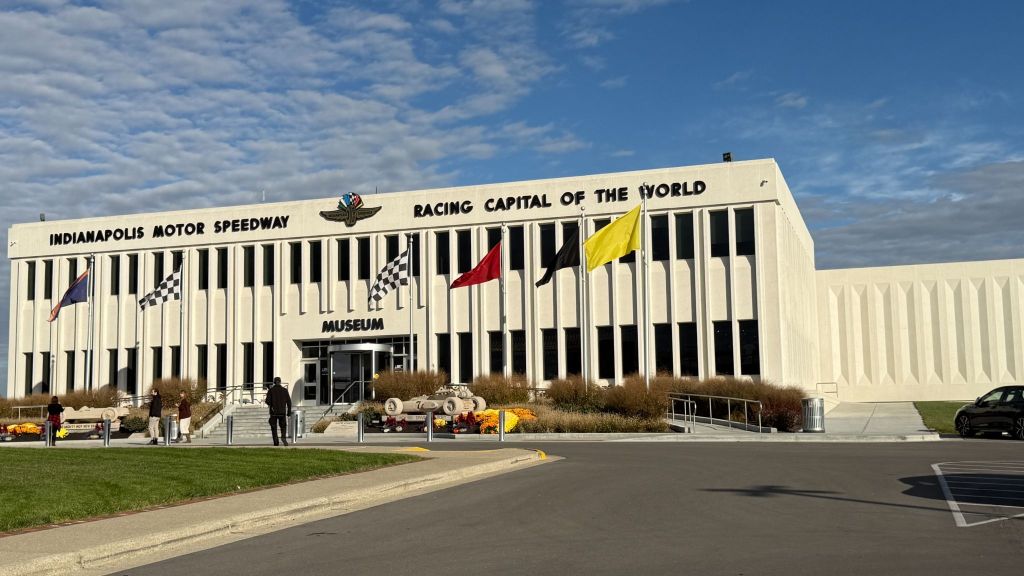
The Race of Champions was founded in 1998 by Ford Wilson, who wanted to provide all children, regardless of abilities, the chance to race. In 2010, it was renamed The Ford Wilson Race of Champions in honor of his memory and dedication. In 2024, the Museum took over the operations.
The goal of this community initiative is to provide a free, safe, unique, and fun experience and to empower those who may otherwise never know what it feels like to cross the finish line as a champion.
Constraints
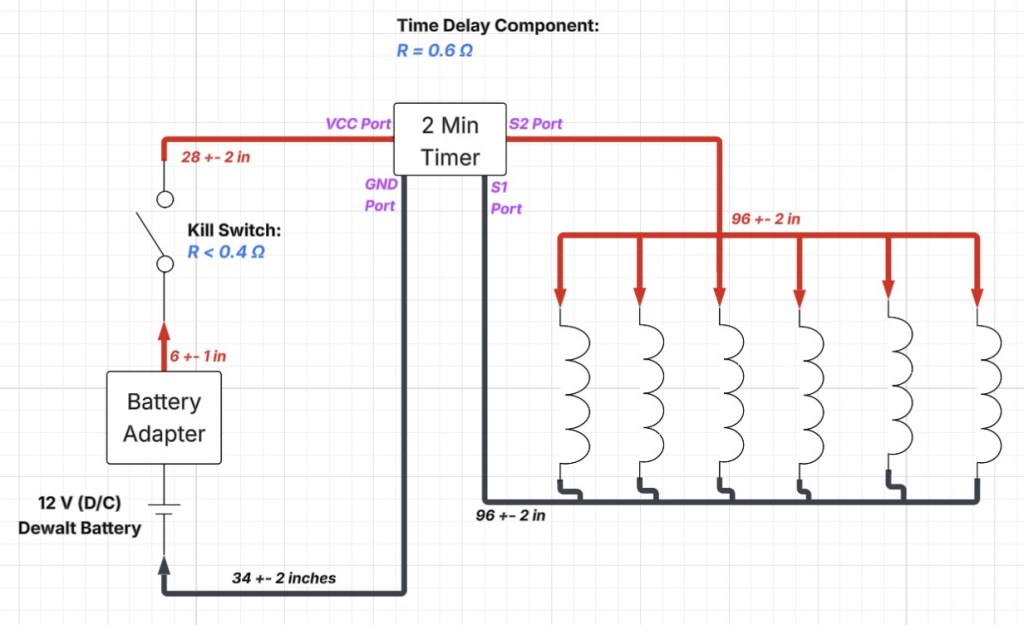
- Fully removeable
- Driver in back needs to be able to take control of car whenever
- Timer trigger in case driver forgets to turn off
- Lowest cost possible
- Limited materials
- Functioning in time for race in September
- Weather-proofed
- Doesn’t heat up
- Protects the disabled person at all costs
- 12V battery only
- SAFE
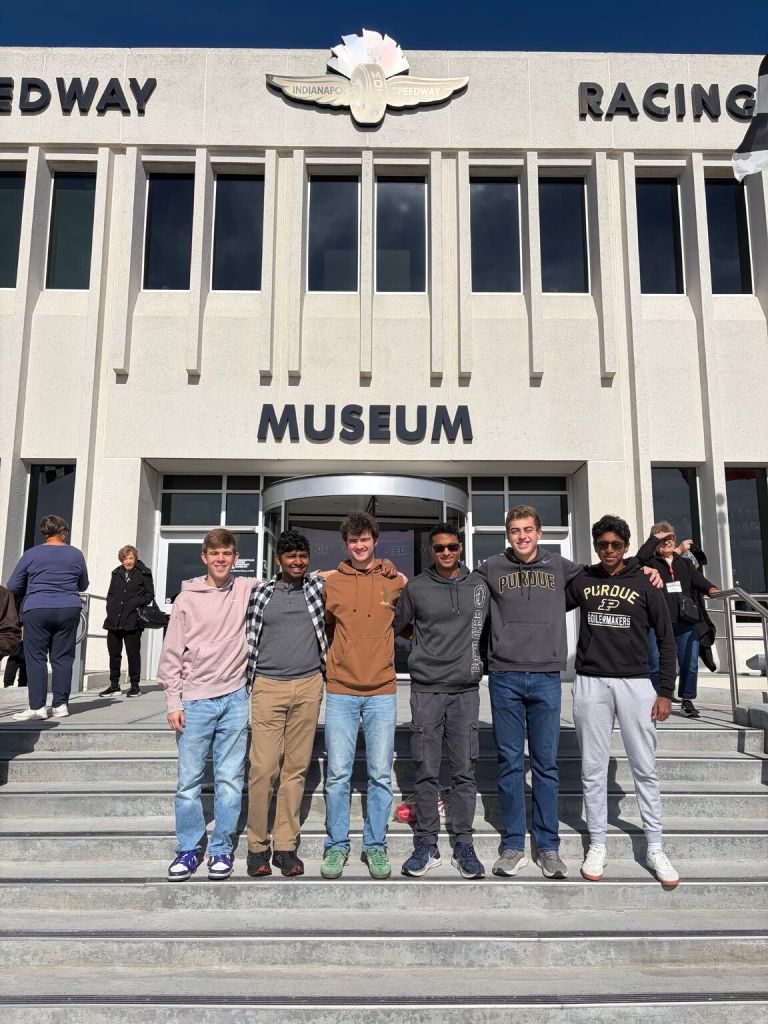
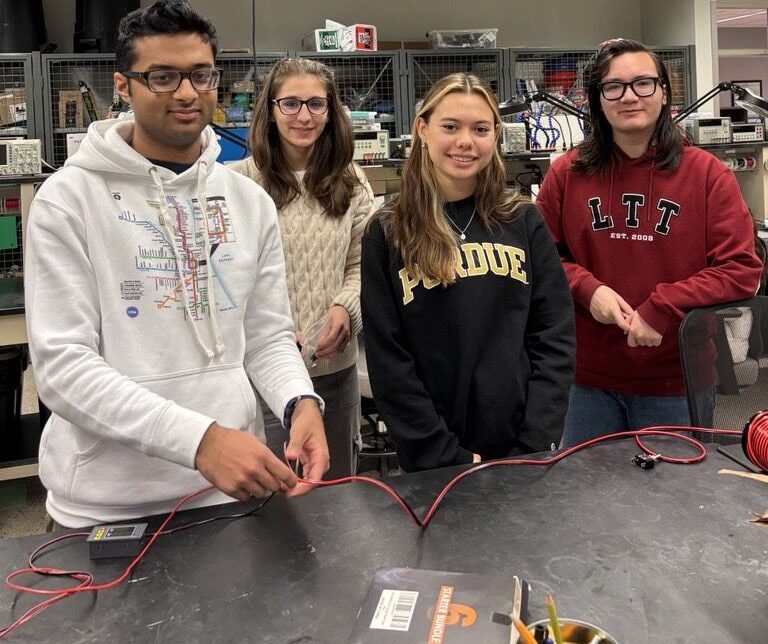
Meet our Team
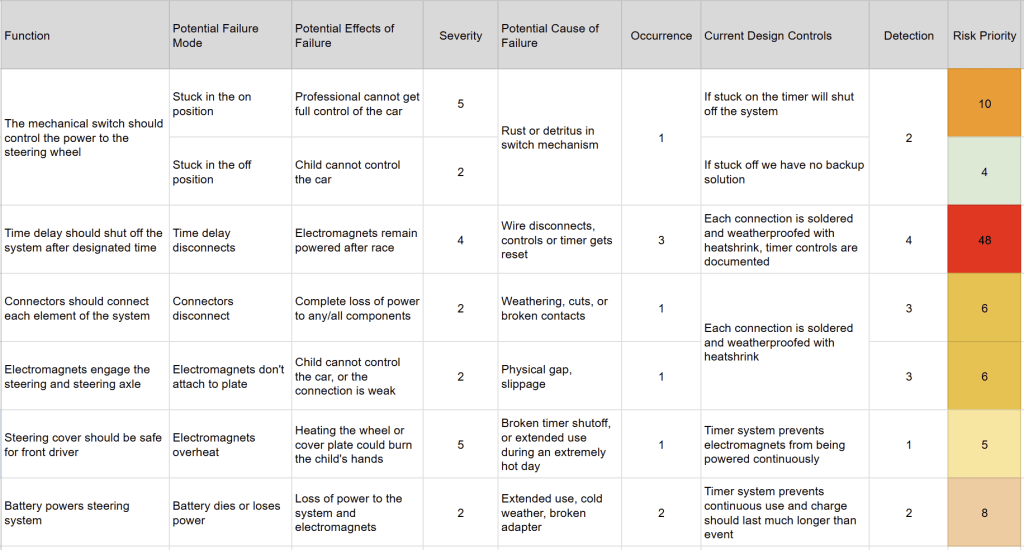
DFMEA
Electrical Harness Design and Weekly Notebook
- Week 8: Harness Prep & Timer Programming
- Measured, cut, and stripped primary power wires for the harness, extending wire lengths to accommodate new chassis mounting holes.
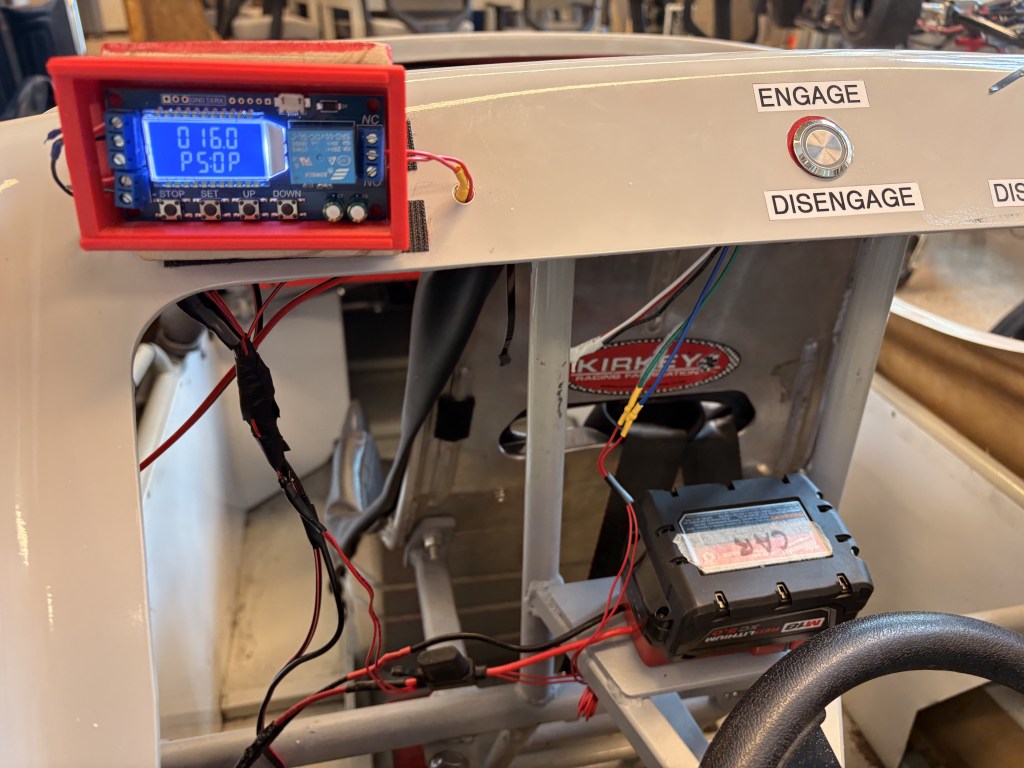
- Successfully programmed the new time-delay module to a 2-minute cycle, replacing a previously damaged unit and resolving internal resistance issues.
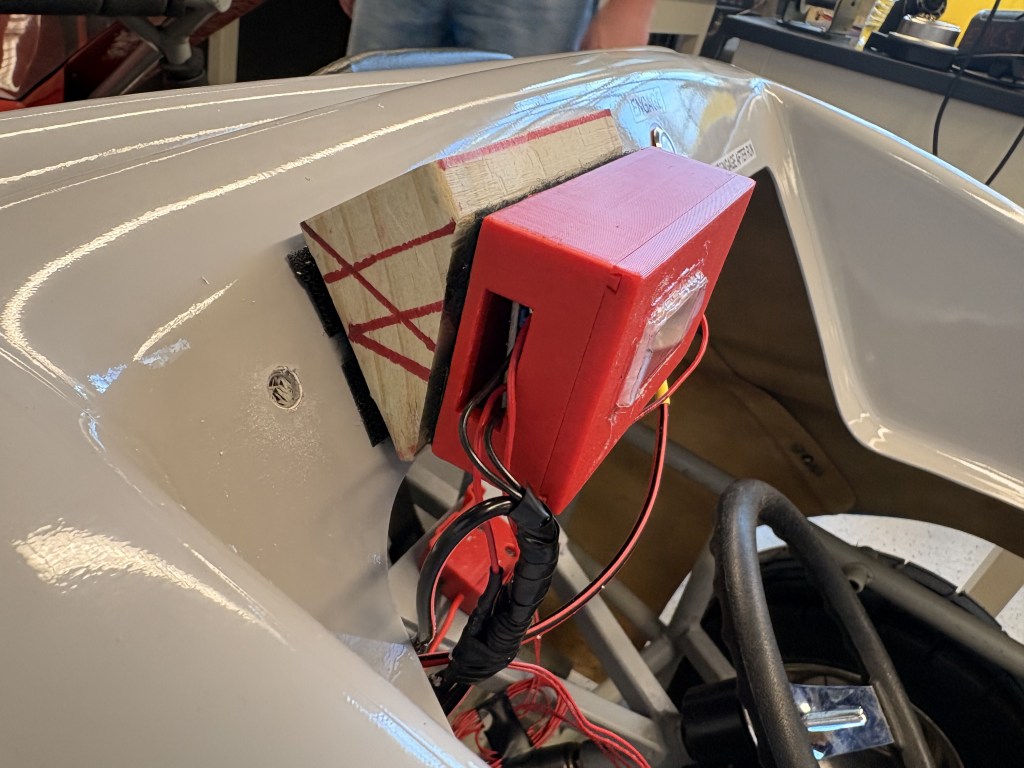
- Established physical specs for the mechanical team to 3D-print a weatherproof protective box for the timer circuit.
- Learned hands-on component verification techniques before circuit integration to prevent component failure in personal and professional engineering projects.
- Week 9: Pediatric Mobility & Inclusive Design
- Explored pediatric mobility principles, focusing on how therapeutic needs, enjoyment, and vehicle design intersect for young drivers.
- Analyzed accessibility resources across local organizations including Wee Speak, G.L.A.S.S., Indiana First Step, and the Arc of Tippecanoe County.
- Evaluated how modular design allows accessibility features to adapt to diverse physical needs while balancing the risk of higher degrees of freedom (DOFs).
- Week 10: Wire Analysis & Design Ethics
- Identified differences between copper-core and silver-colored wiring from the battery adapter, evaluating electrical resistance and joint integrity.
- Analyzed the safety implications of joining dissimilar metals in a low-voltage harness based on prior prototype performance.
- Reflected on the balance between functional lab prototypes and long-term user safety, emphasizing documentation and acknowledging design limitations.
- Week 11: Flyback Diode Testing & Harness Assembly
- Tested circuit back-feed behavior with a flyback diode, diagnosing a blown diode and verifying circuit functionality without it.
- Simulated system button signals using jumper leads to confirm the timer’s P6 program settings prior to physical switch installation.
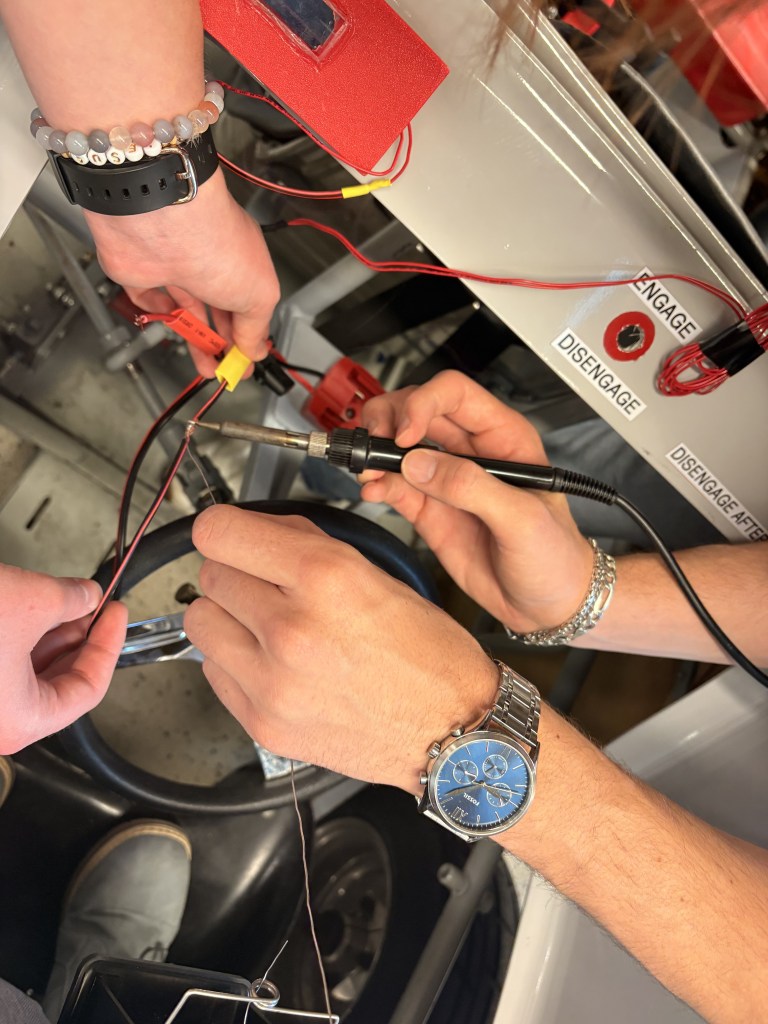
- Finalized, resoldered, and heat-shrank key wiring joints in coordination with mechanical team packaging requirements.
- Week 12: Weatherproofing & Solder Insulation
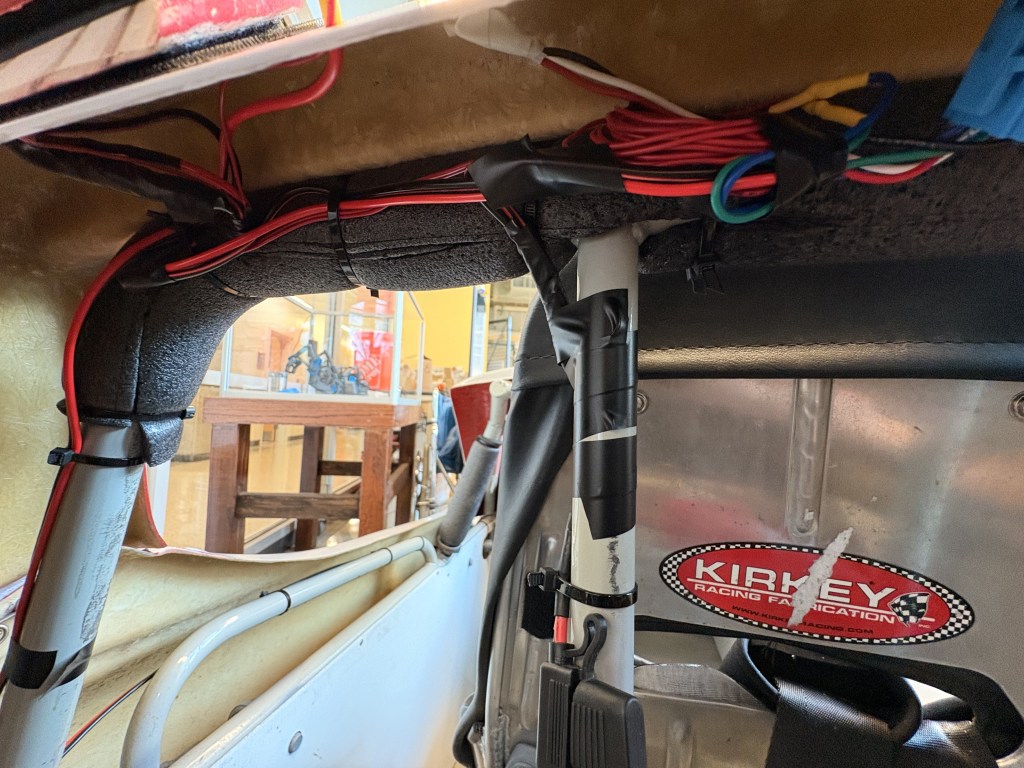
- Engineered a custom weatherproofing method using oversized heat shrink, tweezers, and electrical tape to fully seal complex multi-wire solder joints.
- Attempted initial vehicle installation, discovering harness wire length constraints caused by bulky tape insulation.
- Applied practical hands-on problem solving to weatherproof critical electrical connections using standard lab materials.
- Week 13: Cockpit Fitment & Solitary Problem-Solving
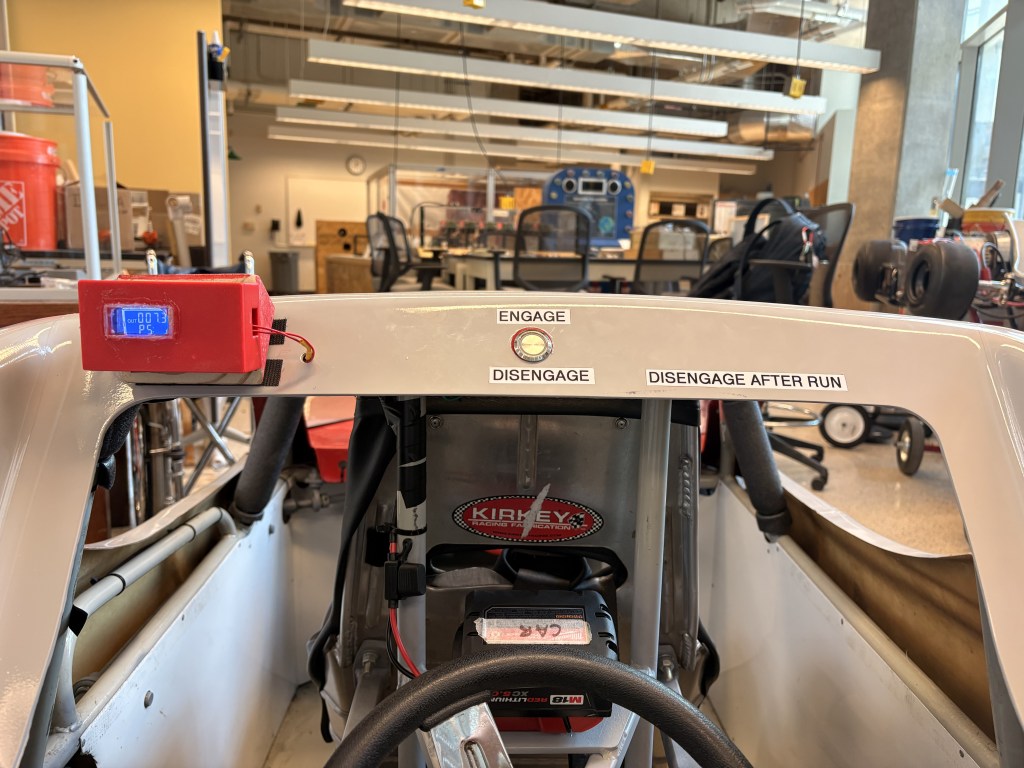
- Integrated a custom angled block with Velcro behind the timer, optimizing line-of-sight and visibility for the driver in the cockpit.
- Diagnosed a blown 20A fuse during power-up and upgraded system protection with a 30A fuse.
- Modified chassis pass-through holes and applied strategic zip-tie strain relief during solo lab hours to achieve proper wire reach without resoldering.
- Week 14: Final Presentation Preparation
- Condensed technical electrical and mechanical sub-system details into a streamlined presentation slide deck.
- Conducted team practice sessions to refine oral delivery, ensuring concise communication of technical achievements and design decisions.
- Week 15: Design Review & ASME Journal Proposal
- Successfully presented the completed accessible vehicle design to project reviewers and stakeholders.
- Received reviewer recommendations to publish the team’s accessibility user manual in an ASME journal as an open-source design standard.
- Finalized project documentation, portfolio assets, and LinkedIn updates to showcase real-world engineering project delivery.
Full Notebook Reports
First, we cut some of the major wires to the length for the harness, we had to make some of them longer due to moving the timer location and the newly drilled holes in the car’s frame(that IMS added). We stripped the wires, and labeled them with tape to revisit on a later date. We did this in parallel with timer testing, which ended up successful. The group working on the timer, programmed it to 2 mins, a big challenge as we fried the one last semester. I think we fried the old one due to some kind of difference in internal resistance of the timer, but we’ll never know for sure. We gave the mechanical team some general loose requirements for creating a 3D-printed box to protect the timer since a chip isn’t very weather-proofed. We did as much prep as possible while waiting for our button.
I knew that we should test components when they arrive, but I also got to learn how to do that, so I got to learn something new, and it is something that I will keep in the back of my mind in the future. Especially on my personal projects, because I was recently trying to implement a timer on a personal project and didn’t know how. So I think that would fall into the academic enhancement theme.
During Week 9, we had the Go Baby GO presentation while waiting for the delayed button to arrive. The presentation focused on many aspects of pediatric mobility design(big words I know), including the idea that mobility should be enjoyable(thus the car-ish design), that devices can support physical therapy needs depending on the child(and/or client), and that products can be customized for different users(modularity). I also looked into community organizations such as Wee Speak, G.L.A.S.S, Indiana First Step, and the Arc of Tippecanoe County. Overall, this week expanded how I think about the impact of engineering decisions, particularly on children who likely don’t understand the concepts behind these designs.
Moving forward, I’ll pay more attention to how large the range of disabilities can be since our design is specially for people with disabtilies. Often these users can’t advocate for themselves, and feedback isn’t. This pushes me to think what it would be like to be them and make something that would work in less obvious ways.
Mobility is not just about function, but also about independence, enjoyment, and flexibility for different users. That’s why modular design stood out to me, it’s one of the most complex things about engineering, it allows solutions to be adapted rather than forcing a single fixed design, which means a lot of moving parts, and thus more degrees of freedom. The more DOFs, the more room for error. The more room for error, the harder the design and upkeep is, meaning we have to really think through “fool-proofing” of the design.
Week 10 was mostly about dealing with an unexpected ethical/design issue. We were working with copper-centered wire, but the new setup required connecting it to a silver-colored wire from the battery adapter. That raised questions about resistance differences and whether it would affect performance. To check, we cut into our previous wiring and realized the wire actually had two different metals inside(same as the wiring we noticed this time). Even with that information, we still decided to move forward with soldering since the old harness worked at least once. I think that this could be an ethical issue as it leaves a big question mark of “is this safe”, and then we can have a whole debate on whether or not, skipping the answering pf that question is ethical. When do we say “it’s good enough”?
This is closely related to engineering ethics where the question is not only whether something works or not, but rather recognizing the risks and compromises involved in the aftermath. Just because it worked in the lab consistently doesn’t mean it won’t later. The failure to acknowledge or document any issues that could arise from the mixed metals might be considered an issue in itself. This showed me how engineers must be open to the fact that there may be limitations, and they cannot always insist on functionality alone. Ethics applies to each stage of engineering from the ideation to the delivery.
We finalized and reworked several soldered wire connections. One connection had to be undone after we connected the flyback diode, and mechanical had to slip something on. We took it as an opportunity to separately test the diode…which we promptly blew up. We tested without the diode…and it worked. We scheduled a meeting with mechanical for next week to finish the rest of the solder points. We still didn’t have the button yet, so we used a wire to act like a trigger signal and tested how the mock button would function in the system. This confirmed the previous timer-testing of the P6 setting, and we ended lab with heat shrinking everything
In the future, I’d like to learn more about flyback diodes as blowing it up is not exactly what we had in mind. I thought I understood the connections, but clearly not. I think in the future I would like to do more testing with flyback diodes and see how they act differently in comparison to normal diodes, LED’s, and resistors. I think this principal of testing something we don’t fully understand until we understand it, is one of the core principals of EPICS, and future companies, and a value they will hold us too.
In relation to this week’s experience, one realization was how engineering requires a great deal of communication(I like engineering not just for the design but also the lack of writing) rather than simply being an iterative process. I learned there is a whole lot more writing than I would desire, but it is a integral part of communication and making sure we are doing the steps in the correct fashion. Like building lego bricks, you’ve got to do it in order and just because your manual makes sense alone doesn’t mean the other manual will perfectly line up later.
A lot happened this week in regards to creativity. We had to figure out the best method to weather proof some of our mulit-way solder points. To solve this, we took a massive piece of heat shrink, like ¼” wide, and cut it down the middle. We used tweezers to hold it shut while we shunk the material which is harder than it sounds. We did the same to the other side and then put electrical tape around it for extra protection. We tried to install it in the car, but had to cut back a lot of the tape since some of the wires came out too short(a problem for next week).
I think in the future there are better ways we could investigate how to weather proof connections like that. At least better than what we had access to in the lab and I would like to research how real world companies solve a problem like this. I think we learned a lot from this process as we started with a over sized piece of heat shrink and then moved to a bigger and then bigger piece until it worked, but there is still room for a lot more learning from this. What else can we weather proof with?
I could say this week’s theme theme could be academic enhancement as we worked mostly technical with what we had on hand with future dreams to do more research with better materials and time. I think making do with what we had on hand is a very ME-esque job(my discipline) as many mechanical engineers start out tinkering with whatever is in their garage. It’s how start-ups…well start up. Honing such a skill could prove to be beneficial in the future.
We spent time during lab further cutting down the electrical tape and trying to get the wires to reach into the timer. We also idenitided the need for a angled block behind the timer so the driver could see it more clearly, something we attached with velco. We were able to get a model of the block in, and were not able to get the wires in. At the end of the class, the system stopped working, noticed the 20A fuse blew, replaced it with an 30A we found in the locker and called it a day. I kind of found myself addicted to getting the project fully done so I went to lab, alone, after class for a little over an hour and got creative in getting the wires to fit. I knew that I did not have to time to cut new wires and resolder half the system, so I made one of the holes bigger and with some careful zip-tie-ing, got the wires just long enough to connect to the timer.
Reflecting, I think we should have been more careful in our measurements. But in the future, we would make the wires the correct lengths to account for adding things like the block.(the wires fit fine without the block). As for skills, I think that getting to spend this time alone with the system was great for my understanding, and something that I think could be carried on through EPICS.
I think this week can be the rare personal development. I’m definitely an extrovert, I like to talk, I like to debate, but spending that time alone was really important for me to just kind of observe and understand without everything going on around me. So I guess it’s reaffirming a strength that I really do know what I am doing, just sometimes it’s shown better without everything clouding judgement. I think over all, I learned a lot about electrical, but also that balancing that team and alone time during design is more important than I had realized.
During week 14, we mostly we just organized our slides for the final semester presentation, and then we assigned people to each, trying to make it as short as possible. Following that on our weekly meeting, we met online at 6pm as usual, and then we practiced the few things we were going to say for the slides. It was a very simple meeting, one where we did not touch the system at all, not even to get more videos. So I don’t think there is much of an experience to report on as we didn’t really do any learning. We are college students, we know how to make a slide show.
I would have to file this week under academic enhancement. Even though we didn’t learn anything new, we still practiced things that will benefit us in the future. We need to know how to present cohesively as a team in technical presentations in the work place and how to condense the information shown so just show the most important parts.
This week was not like our other weeks but rather we had our final design presentation. I would call this week professional development since one of the reviewers brought up posting our user manual in a ASME journal. I really liked that idea and think it would be a great way to tie up this project that’s been going on for nearly a decade. We also took photos with the car for our linkdln.
Coming back to my first point about what we did, pondering publication, updating linkdln, and having a smooth presentation is definitely a form of professional development as these are things we can utalize in the work place later. Hiring managers want to see that we have projects, that we can present. Showing these things online can act like proof.